

Product Overview
Updated: June 15, 2026
FireTail is a security platform for discovering, securing, and monitoring AI resources across their full lifecycle. It integrates with cloud environments, code repositories, and API gateways to provide continuous visibility, risk assessment, and runtime protection for AI-powered services.
Dashboards
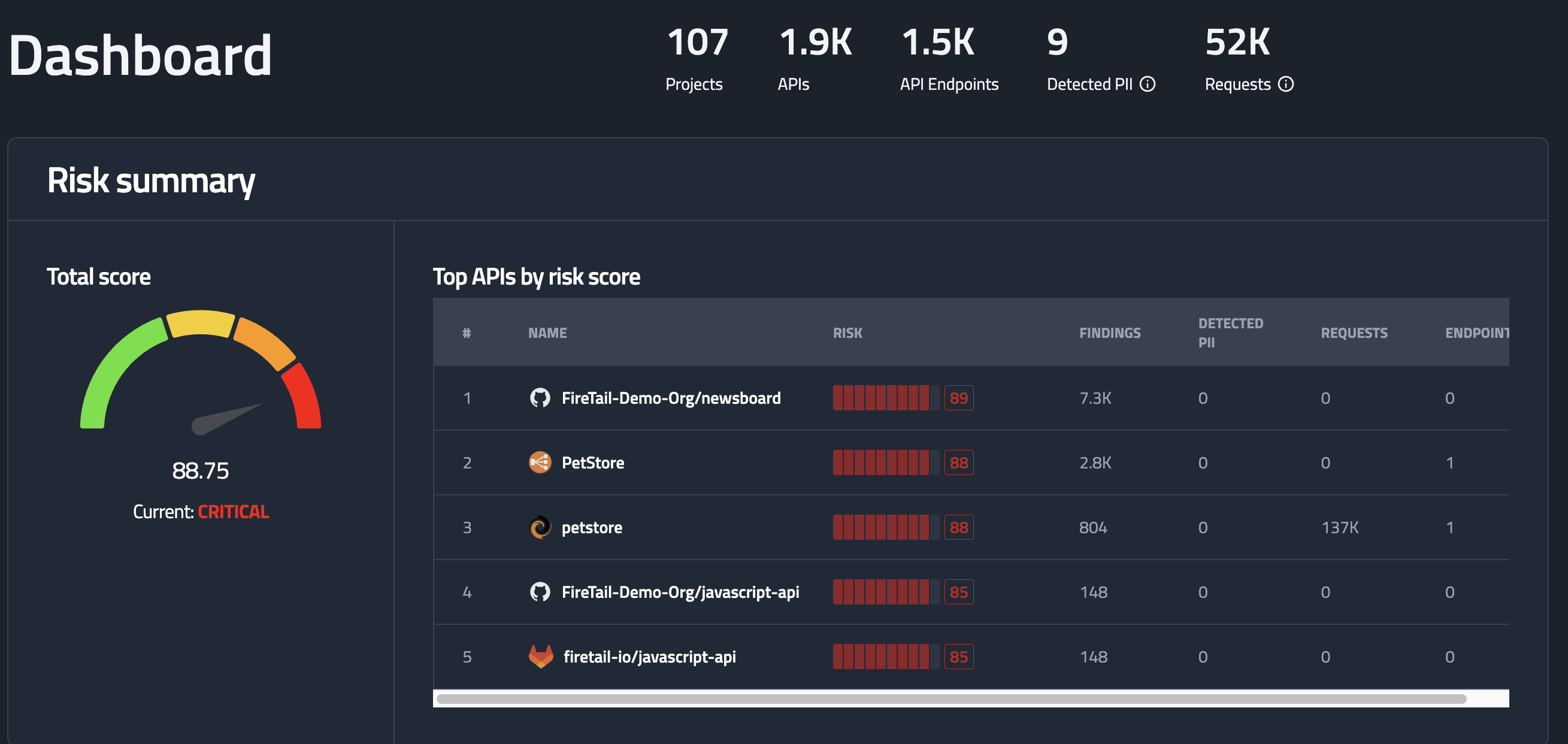
FireTail provides four dedicated dashboards: Workforce Risk, Workforce Usage, Workload Risk and Workload Usage — delivering real-time visibility across your organization's AI activity. Each dashboard consolidates key metrics and offers dynamic filtering to help teams monitor usage, detect anomalies, and respond to emerging risks. They offer centralized insights into AI service connections, usage metrics (like token volume), and resource grouping by provider. These dashboards support operational awareness and accelerate incident response with high-context, data-rich views.
Discovery and Inventory
Use FireTail to discover, monitor, and manage AI resources across cloud environments and code repositories. Through integrations with providers such as AWS, Azure, Google Cloud, GitHub, and GitLab, FireTail provides two complementary AI visibility capabilities. AI Workload identifies AI services, models, prompts, agents, and their associated logs, organizing assets by provider, tracking token usage, and surfacing critical metadata such as response formats, latency, and safety guardrails. AI Workforce extends this visibility to the human side of AI adoption — monitoring and managing the employees, devices, applications, and groups within your organization that interact with AI platforms. Combined with custom policies and inline-content monitoring, this offers comprehensive insight and control over how AI is used within your organization.
Posture Management
Findings
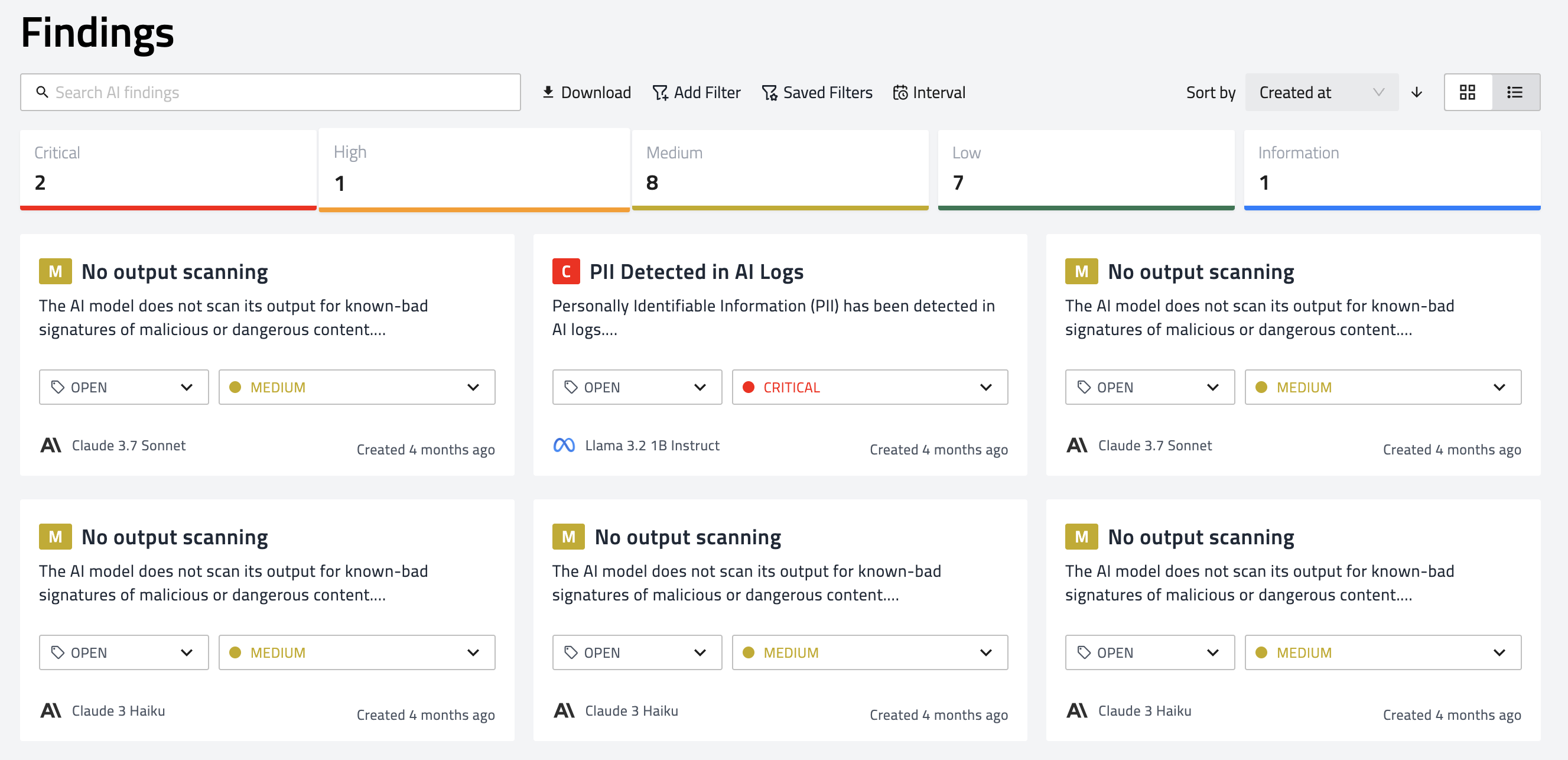
The Findings feature provides a system for detecting and tracking security risks across AI systems. In the context of AI, findings capture instances where models produce unsafe, misleading, or unintended outputs-such as leaking sensitive data, generating malware, or responding to adversarial prompts and jailbreak attempts. The system also monitors operational anomalies like elevated latency, spikes in token usage, and exposure of personally identifiable information in logs. Findings are generated from multiple sources, including repository scans, usage logs, and active security scans, ensuring a continuously updated view of an organization's posture. Each finding includes a clear description and remediation guidance. This enables the detection of misuse early, improves system resilience, and maintains alignment with security best practices.
Model Scans
Automations are FireTail's automated security workflows, designed to test and monitor your AI Models with minimal manual effort. They support both event-driven and scheduled execution, enabling organizations to trigger scans based on AI activity or at fixed time intervals. Each Model Scan can be built using either custom integrations (e.g., your own Lambda or Webhook) or managed model-scans-ready-to-use tools provided by FireTail for specific scanning tasks.
FireTail's managed model scans perform deep and wide-ranging security checks, with over 3,000 tests available. These include:
- Fuzz Testing: Automatically send malformed or unexpected inputs to detect crashes, injection flaws, or parsing issues.
- CVE Detection: Scan endpoints for known vulnerabilities across a wide library of public CVEs.
- GraphQL Testing: Identify common GraphQL-specific vulnerabilities like introspection leaks, field overloading, and CSRF vectors.
- SSL Vulnerability Detection: Detect weak cipher suites, untrusted certificates, and other SSL misconfigurations.
- Data Exposure Detection: Identify exposed credentials, log files, and public-facing Swagger or OpenAPI interfaces.
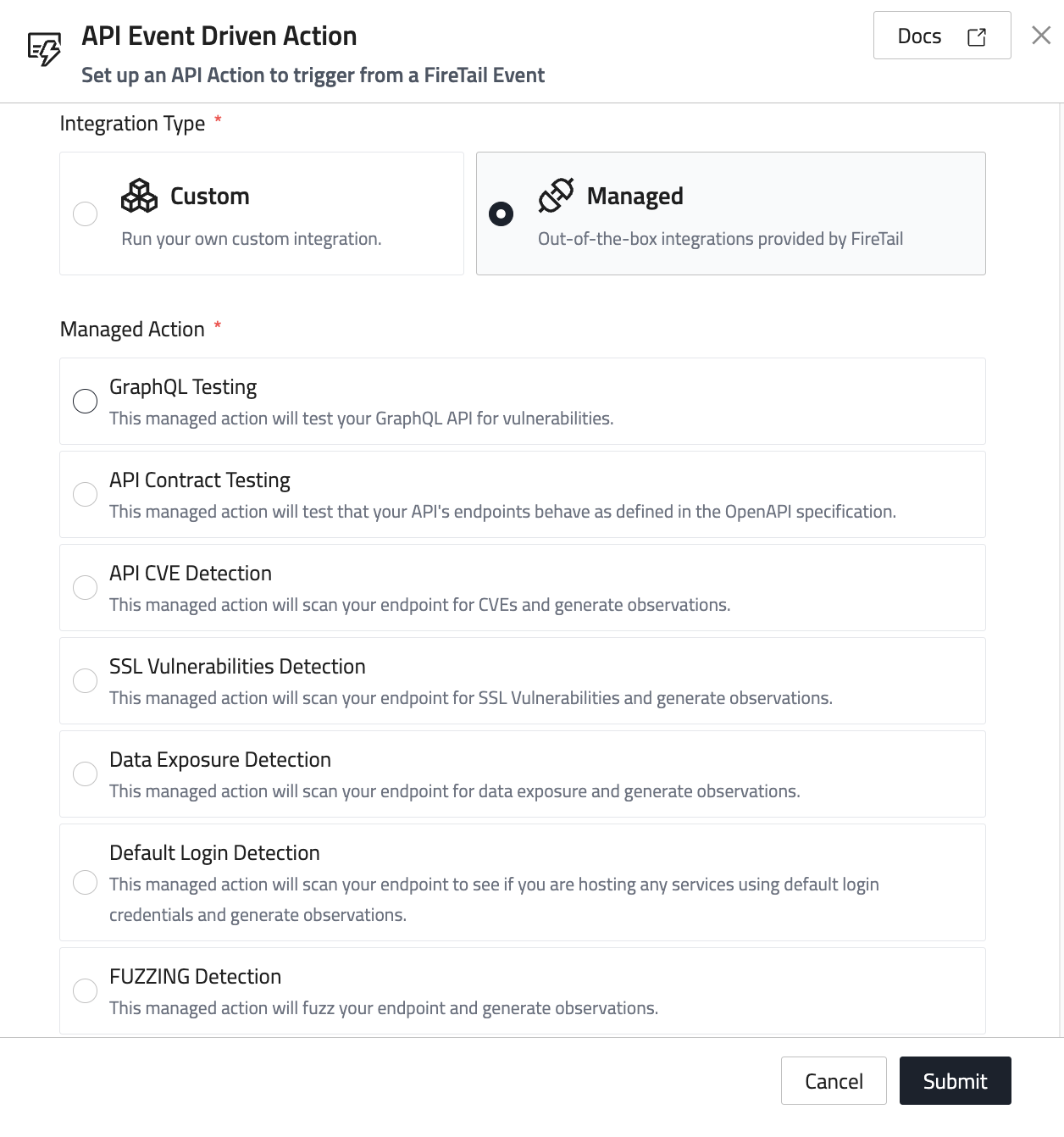
Model Scans can be fine-tuned with configurable parameters including authentication, headers, context keys, and more. Whether you're integrating them into an automated CI/CD pipeline or responding to live AI events, Model Scans allow security teams to validate AI Model resilience continuously and with precision.
Logging
FireTail centralizes AI activity logging to provide actionable insights and enable threat detection.
Log Sources
- Logs from FireTail libraries.
- Logs from network resource types.
- Integrations.
Log Enrichment and Analysis
- Enriched logs help build custom detections and improve threat analysis.
- All logs are accessible in the FireTail dashboard with filtering options for status codes, execution times, and more.
Alerting
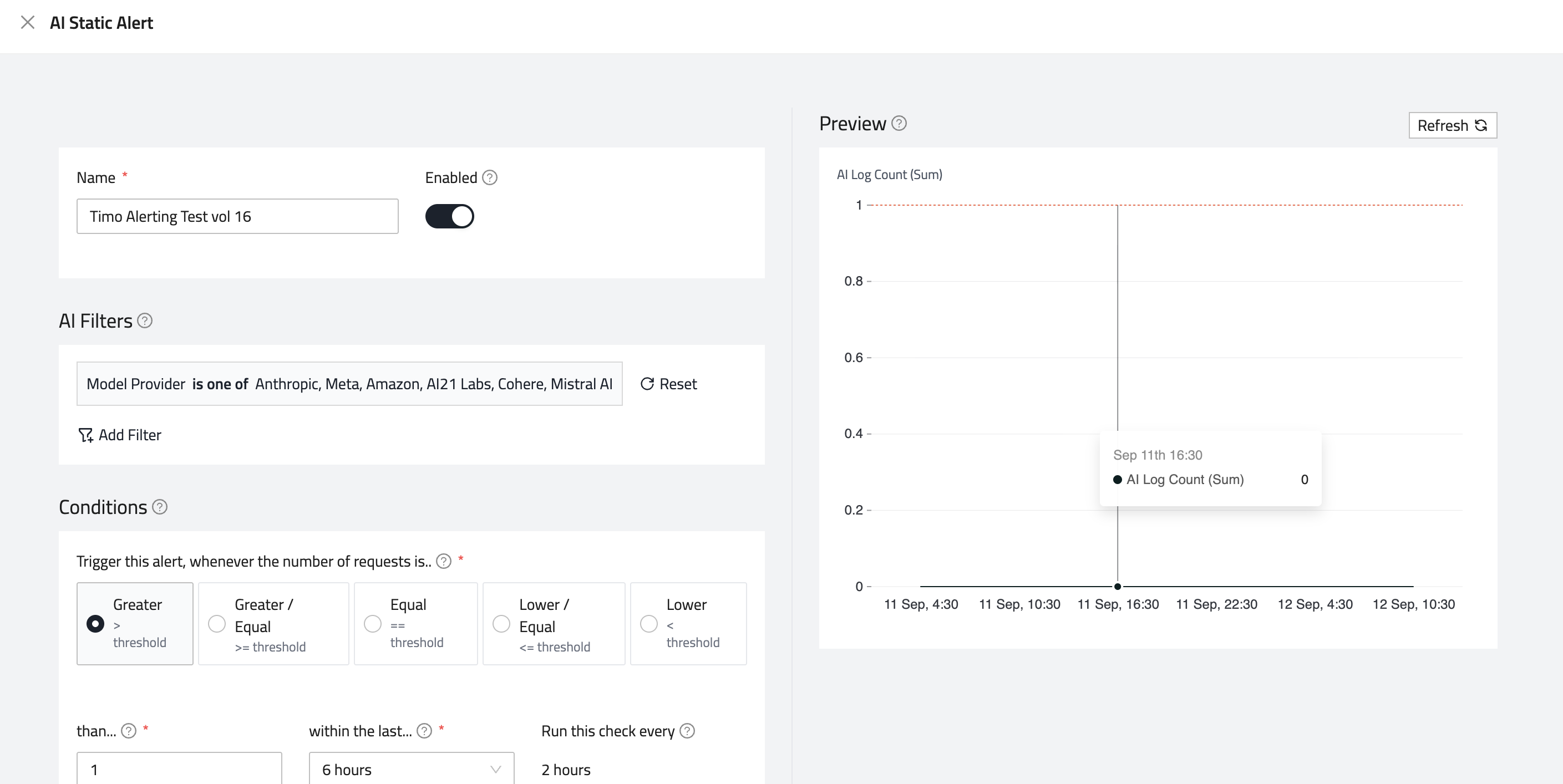
FireTail's alerting system enables proactive monitoring of your AI environment by triggering notifications based on specific conditions or anomalies. You can set static alerts, which are triggered when predefined threshold values are reached, or anomaly alerts, which use historical data to detect unusual activity that falls outside normal patterns. FireTail also provides pre-configured managed alerts designed to identify common security threats, such as SQL injection or unauthorized access attempts. Alerts can be integrated with various notification channels like Slack, Jira, or SIEM systems. This ensures you are quickly informed of potential issues, enabling swift response and resolution.
Summary
FireTail is a comprehensive security platform designed to protect AI resources throughout their entire lifecycle. It integrates with cloud platforms, code repositories, and API gateways, enabling continuous discovery, inventory management, and real-time monitoring of both AI services. Built on established security frameworks and best practices, FireTail provides advanced tools for assessing security posture, logging activity, and responding to incidents. It helps organizations identify vulnerabilities, detect threats, and implement effective mitigation strategies.
With FireTail, you gain deeper visibility into your AI environments, enabling proactive monitoring of traffic and resource usage. Its rich contextual data supports rapid response to security events, ensuring that security risks are addressed promptly. This comprehensive approach helps reduce breach potential, maintain compliance, and improve the overall reliability and security of both AI infrastructures.